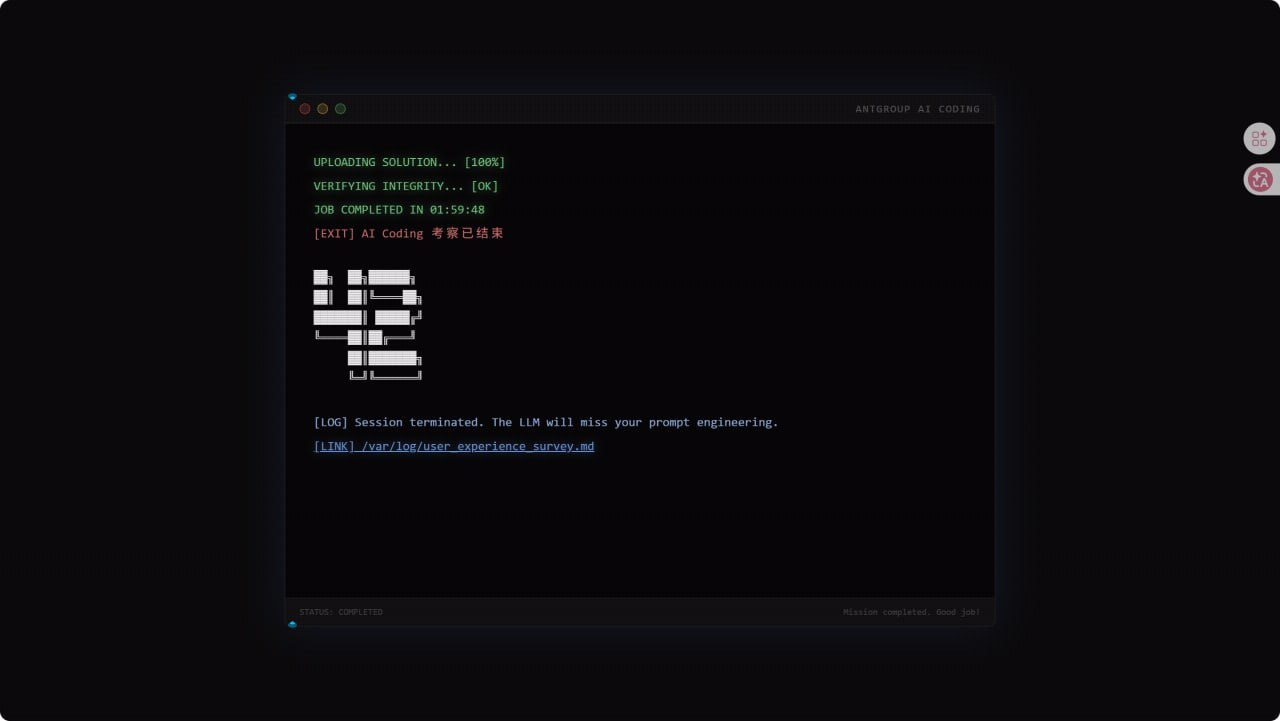
Timeline: the 18th
This was probably the day I properly began preparing. I did not normally write long, comprehensive prompts for coding agents, so I was worried about my ability to write prompts during the assessment. I also lacked experience using an agent to build a complete, business-level application.1
I decided to work on two fronts:
- Researching the assessment itself.
- Improving my vibe-coding abilities.
1. Researching the assessment
From posts on Xiaohongshu, I reasoned that there were too many candidates for every submission to be reviewed entirely by humans. Assuming AI-assisted grading, one idea immediately came to mind: prompt injection.2
Beyond prompt injection, I also considered catering to other perceived AI preferences: large amounts of text, exaggerated claims about the code, and excessive documentation praising its performance and structure.
2. Researching vibe coding
I came to see the prompt as a major factor in an agent’s performance. Even a prompt generated directly by another agent seemed better than the one or two sentences I usually supplied.
I also needed to work out general principles for vibe coding, including tests first, planning before implementation, and reasoning from first principles.
I asked Grok and GPT to investigate useful skills, rules, and agents.md files. I read a great deal, but ultimately did not use most of those skills and rules. I adapted Everything Claude Code, distilled and compressed it, and produced a Chinese version. Even then, I do not think I put all of it to use.3
During the assessment
I was nervous at first. I pasted in my prepared prompt, discovered that Git was available, and cloned the agent toolbox I had prepared. I then began feeding the toolbox’s guidance to Ant’s Code Fuse. From a quick search, it appeared to have existed since around 2023 or 2024, although it had not attracted much attention.
The agent read agents.md by default, but did not seem to examine the whole toolbox in depth. I initially tried opening several sessions for parallel work. Different agents reacted differently to the same agents.md, and opening a new session interrupted the previous one. Eventually, I settled on an agent that understood the documentation reasonably well and started developing.4
I encountered these problems, in order:
- The agent did not create a separate
apporsrcdirectory for the application. - My prepared prompt had no workflow for architecture or technology selection. The agent began implementing directly from
agents.md, without an overall plan. Interfaces for optional features were not reserved, leading to repeated changes and errors later. - I emphasized a minimal MVP too strongly, and the agent began with an extremely small product.5
- Opening a new session interrupted the old one, preventing parallel work.
- Context even appeared to leak between agents. Near the end, while completing documentation, an agent seemed to execute a prompt I was still preparing for another session.
- Incremental development on top of a confused early architecture made later features difficult to integrate. For example, the end-to-end encryption module was not wired in correctly.
- Tests were ad hoc scripts rather than
pytesttests, so I could not establish correctness reliably.6 - Dependencies were not recorded properly. The agent even assumed that packages already installed in its environment did not need to be installed elsewhere.
Timeline
0–5 minutes
Installed the toolbox and prepared the session context.
5–10 minutes
Gave up trying to perfect the setup, picked a usable agent, and started development. This produced a very minimal MVP—apparently just two files.
10–20 minutes
Asked the agent to rewrite guidance such as timeline.md, follow a strict table format, and implement required features.
30–45 minutes
Continued adding the required functionality and asked the agent to produce detailed tests.
45–60 minutes
Realized that simply watching the agent work was not useful. I created a human-maintained to-do document to organize the agent’s tasks and construct prompts, while waiting for the security requirements to be implemented.7
60–75 minutes
The AI produced some simple security-related code that I had not yet understood. I realized I could add rules, beginning with first-principles reasoning and a requirement to inspect the code.
75–100 minutes
Asked the agent to add optional functionality and intelligent algorithms, and to strengthen the security algorithms. I added rules emphasizing TDD: design tests before writing implementation, and plan before coding.
100–110 minutes
Prepared two prompts: one to organize the feature documentation and another to explain security and performance. I refined the text of the deliverables and tried to avoid exposing weaknesses in the test report, then ran the prompts.8
110–120 minutes
Ran those prompts, found that the requirements file was poorly written, and asked for improvements. I only just made the deadline.
Key takeaways: Ant Group AI coding exam checklist (CodeFuse)
Across the 120-minute Ant Group AI coding assessment in the CodeFuse environment, the decisive bottlenecks were not prompt length or prompt injection, but upfront architecture boundaries, single-session context control, pytest verification, and disciplined deliverable packaging:
| Exam pitfall | Root cause and engineering fix |
|---|---|
| CodeFuse session interruption | Opening a new session aborted the previous one and leaked context across agents.md runs; maintain a human-owned task board (todo.md / timeline.md) over a single primary session. |
| Over-minimal two-file MVP | Skipping src/ layout and interface planning prevented clean integration of end-to-end encryption; lock module boundaries in minutes 0–10 before coding. |
Ad hoc scripts instead of pytest | Unstructured scripts and missing dependency declarations could not prove correctness; enforce TDD with pytest suites and explicit requirements.txt manifests. |
| Late documentation drift | Chasing optional features until the final minutes degraded requirements clarity; freeze feature scope in the final 20 minutes to align architecture, security notes, and test reports. |
Comments
Share a thought about the article, add a reading suggestion, or ask a follow-up question.